The Penelopiad by Margaret Atwood

Updated: Nov 27, 2024
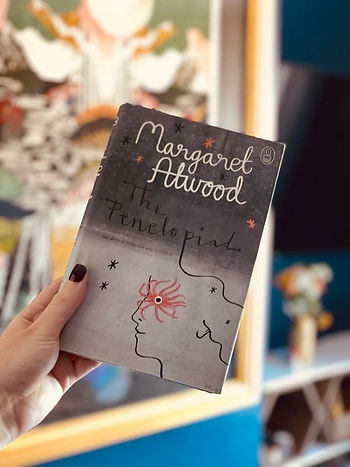
Summary:
In Homer’s account in The Odyssey, Penelope - wife of Odysseus and cousin of the beautiful Helen of Troy - is portrayed as the quintessential faithful wife, her story a salutary lesson through the ages. Left alone for twenty years when Odysseus goes off to fight in the Trojan war after the abduction of Helen, Penelope manages, in the face of scandalous rumours, to maintain the kingdom of Ithaca, bring up her wayward son, and keep over a hundred suitors at bay, simultaneously. When Odysseus finally comes home after enduring hardships, overcoming monsters and sleeping with goddesses, he kills her suitors and - curiously - twelve of her maids.
In a splendid contemporary twist to the ancient story, Margaret Atwood has chosen to give the telling of it to Penelope and her twelve hanged Maids, asking: ‘What led to the hanging of the maids, and what was Penelope really up to?’ In Atwood’s dazzling, playful retelling, the story becomes as wise and compassionate as it is haunting, and as wildly diverting as it is disturbing. With wit and verve, drawing on the storytelling and poetic talent for which she herself is renowned, she gives Penelope new life and reality - and sets out to provide an answer to the ancient mystery.
About the Author:
Margaret Atwood, born in 1939, is a Canadian novelist, poet, and literary critic. She has been published since 1961. Her best-known work is the 1985 dystopian novel The Handmaid's Tale. Atwood has won numerous awards and honors for her writing, including two Booker Prizes. A number of her works have been adapted for film and television.
Rating:
4 stars - ★★★★☆
Review:
I read The Penelopiad in a few hours in bed on a lazy Sunday morning. It was very easy to read, quite engaging and a really great retelling of a well known myth. I love getting a different point of view on a familiar story. I need to add more of these to my To Be Read list.
I do feel slightly cheated by the blurb. It promised the real story of Penelope so I was expecting lots of secrets and intrigue. But she was the intelligent, faithful wife who did her best for the kingdom in her husband’s absence. I wanted something more - some drama and shock and romance.
However, it was a beautiful, evocative story with retellings of Greek myths and new interpretations patchworked in. I’ve just finished watching Kaos so I enjoyed seeing some names repeated. I also ended up imagining Helen of Troy looking like a young version of Hera in Kaos. Margaret Atwood always does such an excellent job of making the narrator speak right to the reader. I always finish one of her books feeling like I know the protagonist intimately. Penelope is a very compelling character, I desperately wanted her to have a happy ending. It was refreshing to have Odysseus portrayed as a sneaky character just frittering time away around the Mediterranean, rather than the glorious hero he is usually depicted as. I also liked the two versions of his exploits that made their way back to Penelope, showing how myths must have first come into being.
The addition of the Asphodel parts was eerie and dark, and it added an intriguing depth to see all the people who had wronged and been wronged by Penelope. I liked seeing another imagining of Asphodel (compared to the Kaos one that I saw recently) - how differently the same place can be conjured up.
I was a little worried about the Maid’s parts at first as I don’t normally read songs when they’re written down in books but these ones do add some drama and feeling to the story. And of course Atwood is a talented poet so they do have a beautiful flow and read very easily.
The final courtroom scene was deeply relevant to our current world of the Me Too movement, and women finally coming forward after years only to be dismissed. How sad to see themes like this repeated for thousands of years.
I definitely enjoyed this book, it was quick and easy to read with fully developed characters and a gripping narrator. A perfect holiday read (maybe while you’re in Greece?), and a must-read for everyone who loves Greek mythology and retellings of familiar stories from a different perspective. Just don’t expect any mind-blowing revelations.
New Words:
Lugubriously: In a sad and serious way
Impious: Showing a lack of respect for God or religion, wicked
Quotes:
“Behave like water, I told myself. Don’t try to oppose them. When they try to grasp you, slip through their fingers. Flow around them.”


Comments